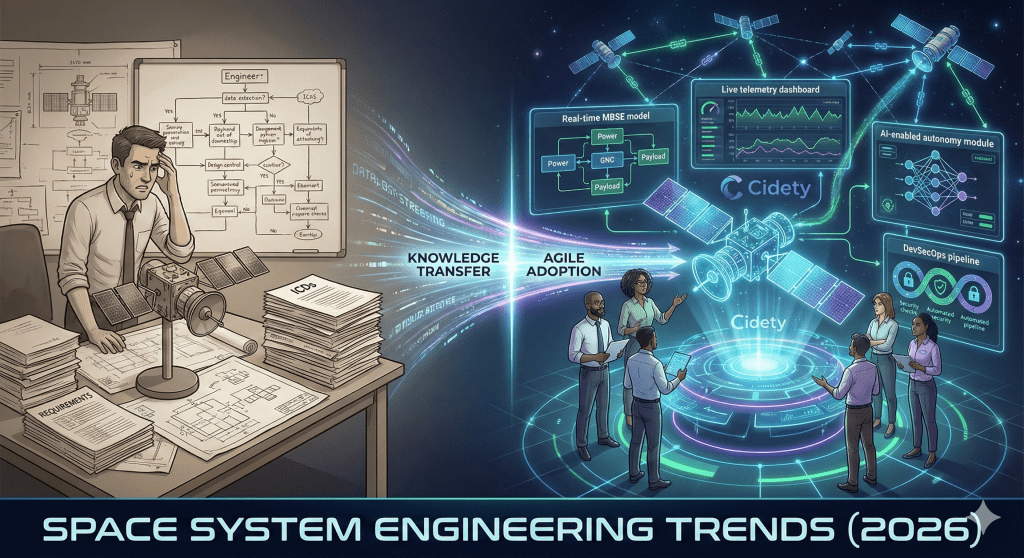
The space industry is currently caught between two opposing forces. On one hand, there is an urgent push for speed and cost efficiency driven by the rise of mega-constellations and commercial timelines. On the other, missions are becoming vastly more complex, facing heightened cybersecurity threats, crowded orbits, and the need for onboard autonomy. This tension creates a specific kind of friction within large aerospace primes. Requirements often freeze too early, or far too late, while verification processes become schedule-killers and “tribal knowledge” remains locked within a few veteran experts rather than being captured in reusable assets.
This is the gap where agile, vertical-market specialists like Cidety provide the most value. We move beyond the traditional vendor relationship of “selling a service” to focus on knowledge transfer. By teaching and embedding engineering know-how directly into a customer’s workflow, we help organizations build sustainable internal capabilities and a shared technical language.
The Evolution from Documents to Executable Architectures
We are seeing a fundamental shift in Model-Based Systems Engineering (MBSE). It is evolving from a collection of “pretty diagrams” into operational models that actually drive decisions regarding interfaces, budgets, and verification. In the most successful modern programs, the model serves as a living contract that aligns software, hardware, and operations. This is particularly critical in the European context, where aligning MBSE with ECSS system engineering expectations is essential for mission success.
The common pitfall for large enterprises is treating MBSE as a parallel universe. Teams often continue to run Excel budgets and Word-based Interface Control Documents (ICDs) on the side, meaning the model never truly “compiles” into reality. We address this by building “thin-slice” MBSE. Instead of modeling everything at once, we start with the smallest model that produces immediate value—such as power allocations or avionics chain interfaces—and then train customer engineers to maintain that model as code. By auto-generating ICD skeletons and running executable scenario checks on modes like safe-mode entry before hardware is even integrated, we eliminate the late-stage integration “fire drills” that typically derail schedules.
Practical Digital Twins and Autonomous Resilience
Digital Twins are also moving beyond the hype of marketing demos into the realm of practical mission support. While many large-scale initiatives get bogged down in tool procurement or high-fidelity physics models that lack a roadmap, the focus should be on maturity and data plumbing. A digital twin is most effective when it evolves; for instance, starting with a reduced-order thermal or power network model and connecting it to real-time housekeeping telemetry. This allows teams to test recovery actions, such as heater duty cycles or load shedding, against a twin before sending a single command to the spacecraft.
This level of digital integration naturally leads to increased autonomy. AI-enabled autonomy is shifting from simple payload analytics to core mission resilience, specifically in fault detection, isolation, and recovery (FDIR). The challenge is that AI often dies in “prototype purgatory” because flight constraints like radiation and determinism aren’t addressed early. By engineering machine learning like a flight-ready subsystem—complete with datasets, verification strategies, and secure deployment—autonomy becomes a part of the mission’s DNA rather than a bolt-on feature. A lightweight model trained on historical wheel telemetry, for example, can flag early degradation patterns and automatically trigger a momentum management adjustment.
Security, DevSecOps, and the Agile Mindset
As software becomes the defining element of mission success, the industry is adopting DevSecOps and Zero Trust principles. Large organizations often struggle here because legacy constraints and heavy processes slow down deployment. However, the modern space environment requires reproducible builds, signed artifacts, and automated security gates for command paths. Implementing pragmatic pipelines allows teams to operationalize these security measures without breaking safety or certification practices.
Ultimately, faster delivery demands that agile principles move beyond software and into the realm of systems engineering. This means adopting “learning loops” and incremental requirements. While large organizations excel at industrialization and risk management, they are often hindered by siloed disciplines and rigid governance. Cidety’s edge lies in combining deep space-domain expertise with the agility to solve immediate bottlenecks while teaching the customer how to maintain those methods.
By co-creating a shared engineering language—built on models, standardized interfaces like CCSDS, and automated artifacts—we ensure that the capability doesn’t leave the building when the project ends. Whether it is an MBSE-to-ICD accelerator or a telemetry-driven digital twin pilot, the goal is to start with high-impact, low-risk slices that prove the value of a modern, integrated engineering approach.


Lascia un commento